


Gasoline High Pressure Water Pump: Guide to Calculating Head & Flow
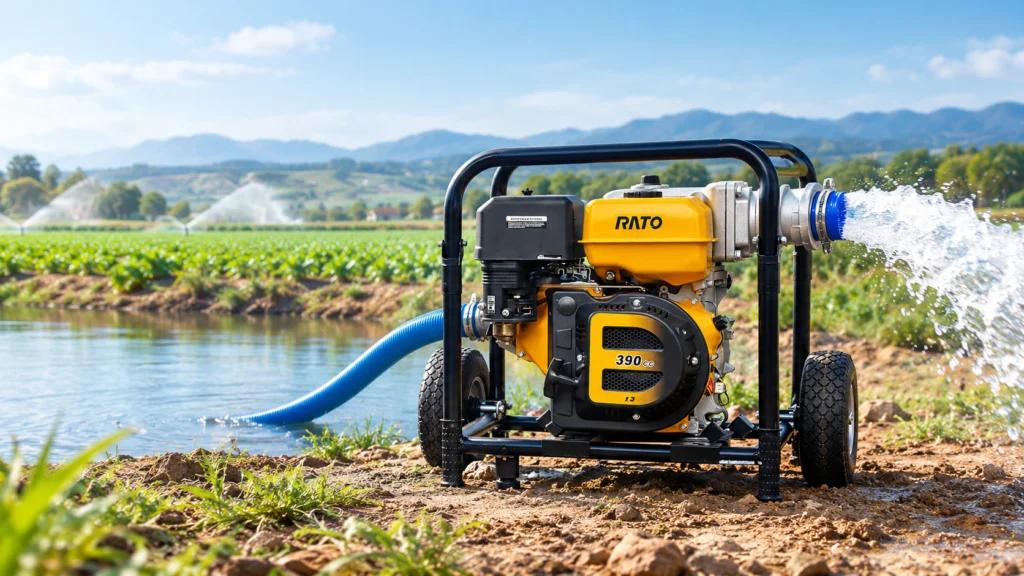
When buying a gasoline high pressure water pump, relying solely on the maximum head or maximum flow listed on a specification sheet is a costly mistake. Actual flow depends heavily on elevation, pipe friction, fittings, and the pressure required at the discharge nozzle.
For demanding applications like agricultural sprinkler irrigation, wildland firefighting, or long-distance water transfer without grid power, matching the pump’s performance curve to your exact working conditions is critical. Here is an engineering guide to properly sizing your next water pump.
The Core Concept: Flow Rate vs. Head in High Pressure Pumps
Two specifications matter most when evaluating a water pump: Total Dynamic Head (TDH) و معدل التدفق (measured in m³/h, L/min, or GPM).
Why Max Head and Max Flow Never Happen Together
A common industry misconception is expecting a pump to deliver its maximum flow at its maximum head. In reality, these are points on opposite ends of a pump’s performance curve. A pump’s maximum head is the highest it can push water vertically before flow drops to zero. Maximum flow is how much water it moves with zero resistance. As the required head increases, the available flow drops. A pump rated for 90m maximum head will not deliver its peak flow at 90m.
How to Calculate Total Dynamic Head (TDH)
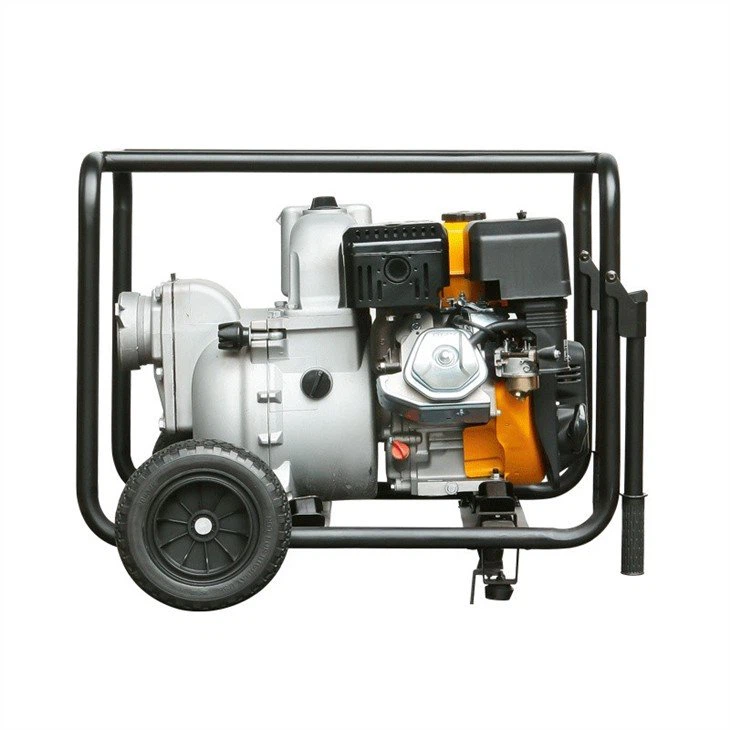
To choose the right pump, you must calculate your system’s TDH. This is the total resistance the pump must overcome to move the water.
Formula: TDH = Suction Lift + Discharge Elevation + Friction Loss + Required Outlet Pressure
Suction Lift (Vertical & Friction)
This is the vertical distance from the water source up to the pump. While self-priming gasoline water pumps typically offer a theoretical 7-meter suction lift, actual performance is affected by atmospheric pressure. At higher altitudes, atmospheric pressure drops, reducing your maximum suction lift and increasing the risk of cavitation. Always keep the pump as close to the water source as possible.
Discharge Elevation (Static Head)
This is the vertical height from the pump to the final discharge point. If you are pumping water up a 30-meter hill to a storage tank, your static discharge head is 30 meters.
Pipe and Hose Friction Loss
For long-distance water transfer, water rubbing against the inside of the hose creates severe resistance. Smaller hose diameters and higher flow rates drastically increase friction loss.
Example: Pumping 38 m³/h through 100 meters of hose:
| Hose Inside Diameter | Approximate Friction Loss (in Meters of Head) |
| 2-inch (50mm) | ~18.5 meters of head loss |
| 3-inch (80mm) | ~2.5 meters of head loss |
Note: Using a 2-inch hose instead of a 3-inch hose for high-volume transfer can rob your pump of over 15 meters of head!
Required Outlet Pressure
If you are using sprinkler nozzles or firefighting equipment, they require specific pressure (measured in PSI or Bar) to function correctly. You must convert this pressure into meters of head and add it to your TDH.
- Conversion Rule: 1 Bar ≈ 10 meters of head. 1 PSI ≈ 0.7 meters of head. If your irrigation sprinkler requires 3 Bar to operate effectively, you must add 30 meters to your total head calculation.
Reading the Pump Performance Curve
Once you have calculated your TDH and know your required flow rate (e.g., you need 20 m³/h at a TDH of 50m), you can evaluate a pump. Look at the manufacturer’s performance curve graph. Find 50m on the vertical axis (Head) and 20 m³/h on the horizontal axis (Flow). The point where they intersect is your “duty point”. You must select a pump model whose performance curve passes on or above this exact intersection.
Which Gasoline High Pressure Water Pump Fits Your Requirements?
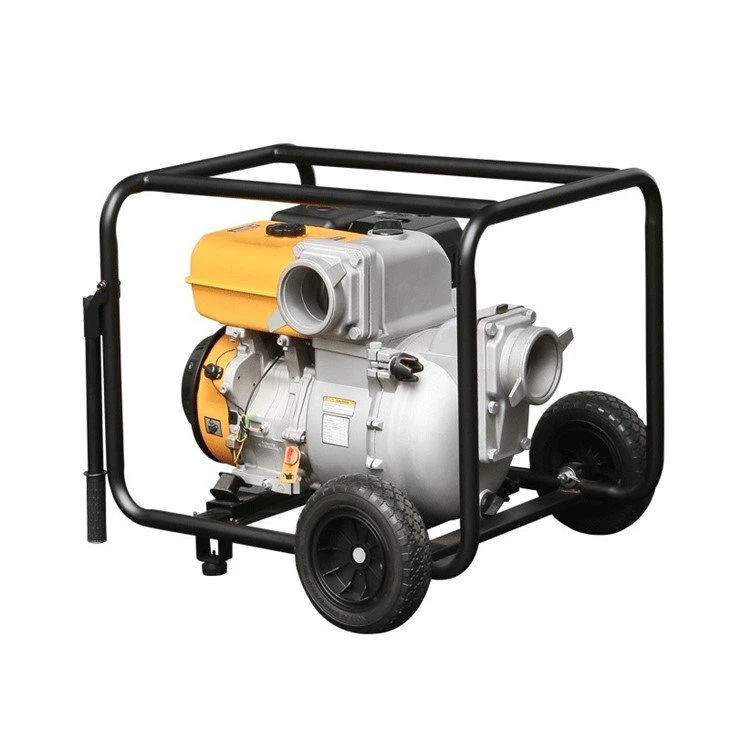
LongdoGlobal YB Series High-Lift Pumps
To meet high TDH requirements, pumps must be engineered with heavy-duty commercial-grade OHV engines, specialized impeller and volute designs, and durable mechanical seals. LongdoGlobal’s YB Series is designed exactly for these high-lift conditions.
| نموذج | قوة المحرك | Port Size | Max Total Head | Max Discharge Capacity |
| RT50YB50-3.8Q | 4.4 kW | 2″ | 50 m | 30 m³/h |
| RT50YB80-3.8Q | 4.4 kW | 2″ | 80 m | 16 m³/h |
| RT80YB70-7.2Q | 8.2 kW | 3″ | 65 m | 38 m³/h |
| RT50YB100-7.2Q | 8.2 kW | 2″ | 90 m | 30 m³/h |
All YB Series models feature a listed 7m suction head lift.
Notice how engine horsepower, port size, and internal pump design change the output. The RT50YB80-3.8Q is optimized for higher head (80m) but lower flow, making it ideal for high-pressure washing or pushing water uphill. The 3-inch RT80YB70-7.2Q utilizes a powerful 8.2 kW engine to deliver a robust combination of substantial head (65m) and high volume (38 m³/h) for demanding agricultural tasks.
See the full مضخات مياه عالية الرفع تعمل بالبنزين (سلسلة YB) specifications for more details.
Best Applications for Gasoline High-Pressure Water Pumps
Wildland Firefighting & Emergency Response: Firefighting requires pushing water through hundreds of meters of lay-flat hose (high friction loss) while maintaining strong outlet pressure at the nozzle. High-lift pumps are essential here.
Agricultural Sprinkler Irrigation: Flood irrigation requires high volume, but running elevated sprinklers or drip irrigation lines requires high TDH to maintain consistent water pressure across large fields.
High-Altitude Water Transfer: Moving water up steep mountainous terrain, remote construction sites, or between elevated storage tanks where grid electricity is completely unavailable.
Need Help Sourcing the Right Water Pump?
A good pump is not simply the one with the biggest specification; it is the one that efficiently matches your system’s engineering requirements.
Before requesting a quotation for OEM sourcing or critical projects, prepare these details:
- Required flow rate (m³/h or GPM)
- Static vertical lift (suction and discharge)
- Hose/pipe length and inside diameter
- Required nozzle outlet pressure
If you are sourcing equipment for agricultural irrigation, long-distance water transfer, or construction sites, LongdoGlobal can help you calculate the exact TDH and recommend the appropriate YB Series configuration.
Explore the مضخات مياه عالية الرفع تعمل بالبنزين (سلسلة YB) أو contact our team today to discuss your volume sourcing needs and technical requirements.
الأسئلة الشائعة
Q: What happens if I use an undersized hose on a high-pressure water pump?
A: Using a smaller hose dramatically increases friction loss. This forces the pump to waste its energy overcoming pipe resistance rather than moving water, drastically reducing the actual flow rate delivered at the end of the line. Always match or exceed the pump’s port size for long runs.
Q: How does altitude affect my gasoline pump’s performance?
A: Gasoline engines lose roughly 3% of their horsepower for every 300 meters of elevation gain due to thinner air. Additionally, lower atmospheric pressure at high altitudes reduces the maximum suction lift, making it harder for the self-priming pump to draw water from the source.
Q: Can a high-head pump handle muddy water?
A: Generally, no. High-pressure pumps feature closed impellers with tight clearances to generate high head. They are designed for clear water. Pumping sludge, debris, or heavy solids can clog the impeller or destroy the mechanical seals. For solid-laden water, a trash pump is required.
